
Current Market Trends
Stay informed about economic factors affecting the real estate market, such as interest rates and employment rates.
Utilizing Market Insights
Use these insights to guide your investment strategies and financial decisions.
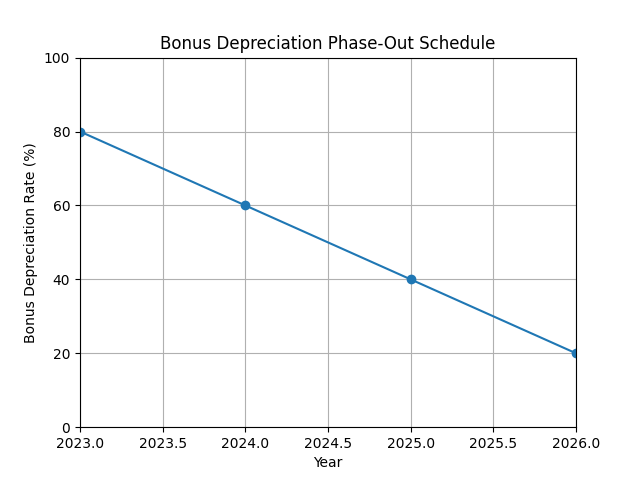
Bonus Depreciation
One of the major provisions in the Tax Cuts and Jobs Act was the expansion of bonus depreciation. The law allowed for a 100% bonus depreciation on eligible property purchased and placed in service after September 27, 2017, through the end of 2022. This means businesses and investors could deduct the full cost of qualifying assets (such as commercial property improvements, equipment, and certain other property types) in the year they were placed in service, rather than over several years.
However, this 100% bonus depreciation is gradually phased down:
- After 2026, the bonus depreciation is expected to revert to 0%, unless new legislation is enacted to extend or modify it.

Qualified Improvement Property (QIP)
The TCJA also corrected a significant technical issue with Qualified Improvement Property (QIP). Originally, QIP (which includes improvements to the interior of nonresidential properties) was mistakenly classified as 39-year property instead of a 15-year property.
This would have resulted in slower depreciation deductions. However, the correction allows QIP to be eligible for 15-year depreciation and, importantly, bonus depreciation. As a result, owners of commercial properties that make interior improvements can now potentially take a large deduction for those improvements in the year they are made.

Understanding the 1031 Exchange: A Smart Strategy for Real Estate Investors
Key Benefits
Tax Deferral: Reinvest proceeds without paying immediate capital gains taxes.
Portfolio Growth: Use deferred taxes to acquire larger or higher‑yield properties.
Diversification: Exchange into different property types or geographic markets.
Estate Planning: Preserve wealth and pass on assets with minimized tax exposure.
In today’s market, 1031 Exchanges are increasingly used to reposition portfolios — moving from management‑heavy assets to passive income opportunities such as multifamily, industrial, or triple‑net lease properties. Investors are leveraging market data, interest rate trends, and demographic shifts to identify exchange opportunities that align with long‑term goals.
Strategic Takeaway
A successful 1031 Exchange requires careful planning, timing, and understanding of current market conditions. Partnering with experienced advisors and staying informed about CRE trends ensures each exchange maximizes both tax efficiency and investment potential.